The modified WhatsApp app is gaining popularity among users seeking more features than the standard WhatsApp version. Among the many options available today, JT WhatsApp APK and WhatsApp Plus remain two of the most popular choices, attracting users with their enhanced customization, privacy controls, and additional messaging features.
At first glance, the two apps seem very similar. They all support messaging, media sharing, customization, and many advanced settings. However, after prolonged use, users will discover some important differences between them.
We have discussed the history and developers of JT WhatsApp before. Now, this article will provide a detailed comparison of JT WhatsApp and WhatsApp Plus, outlining five key differences between them.
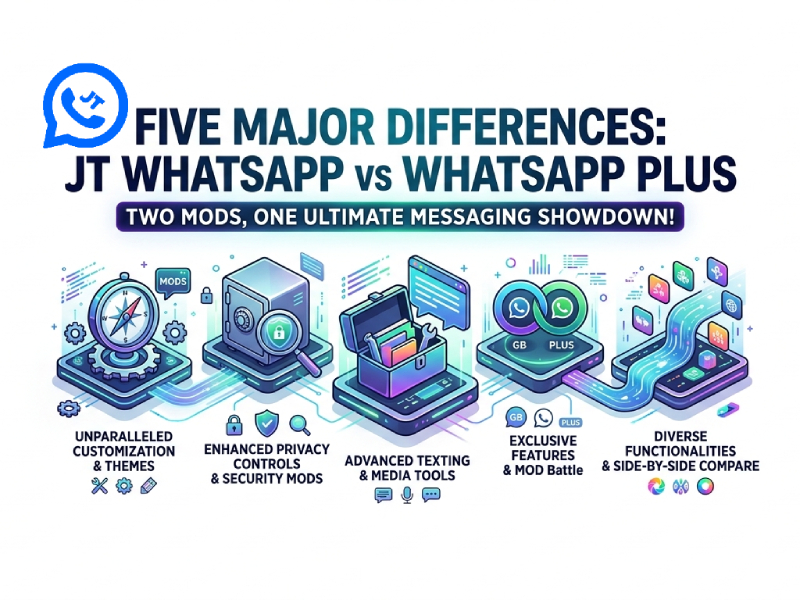
JT WhatsApp vs WhatsApp Plus: Quick Comparison
| Feature | JT WhatsApp | WhatsApp Plus |
| User Interface | Modern and highly customizable | Traditional WhatsApp-style layout |
| Privacy Controls | More detailed privacy options | Standard enhanced privacy features |
| Themes and Appearance | Extensive theme support | Good, but more limited customization |
| Media Sharing | Advanced media handling tools | Enhanced media sharing with fewer options |
| Performance | Feature-rich but slightly heavier | Generally lighter and faster |
1. User Interface and Design
One of the first things users notice is the visual experience.
JT WhatsApp focuses heavily on customization. Users can change icons, fonts, chat styles, notification appearance, and many interface elements. People looking for a free JT WhatsApp download often choose the app because it offers more flexibility than the official version. The app gives users more freedom to create a unique look and personalize their messaging experience according to their preferences.
WhatsApp Plus follows a different approach. Although it also supports themes and visual changes, it keeps much of the familiar WhatsApp design. Many users prefer this because it feels cleaner and easier to navigate.
JT WhatsApp Highlights
- Custom launcher icons
- More interface adjustments
- Advanced chat screen customization
- Flexible navigation styles
WhatsApp Plus Highlights
- Familiar WhatsApp layout
- Easier learning curve
- Cleaner menu structure
- Simpler visual settings
Users who appreciate personalization in every detail typically prefer JT WhatsApp, while those who prefer a familiar interface may opt for WhatsApp Plus.
2. Privacy Features
Privacy settings are another area where the two apps differ.
WhatsApp Plus offers more privacy control options. Users can customize visibility settings for different activities and interactions. These settings are distributed across multiple sections, providing greater flexibility.
Compared to the standard WhatsApp, WhatsApp Plus also includes improved privacy options, but its settings are generally more intuitive and easier to understand.
JT WhatsApp Privacy Options
- Control online visibility
- Customize blue tick behavior
- Hide typing indicators
- Hide recording status
- Separate settings for contacts and groups
WhatsApp Plus Privacy Options
- Hide online status
- Disable blue ticks
- Hide second ticks
- Control typing visibility
People who want more detailed control over their messaging activity often find JT WhatsApp more flexible.
3. Themes and Personalization
For many users, personalization is one of the main reasons for choosing a modified version of WhatsApp. Both JT WhatsApp and WhatsApp Plus allow users to customize the default appearance, but the degree of customization differs significantly between the two. For those wondering why use JT WhatsApp, the answer often lies in its wider selection of themes, font styles, icon packs, and interface adjustments, which provide greater flexibility for creating a unique messaging experience. WhatsApp Plus also offers customization features, but JT WhatsApp generally gives users more control over visual details and overall design preferences.
JT WhatsApp is designed for users who like to customize every aspect of their messaging interface. Users can not only modify the theme, but also change subtle visual details that affect the overall experience. This allows for a unique and personalized experience with each installation.
WhatsApp Plus also offers a powerful set of customization tools, but its design philosophy is more balanced. It doesn’t offer a huge number of adjustment options, but focuses on providing users with enough flexibility to personalize the application without making the settings menu too complicated.
JT WhatsApp Customization Features
- Thousands of downloadable themes
- Custom launcher icons
- Multiple font styles and sizes
- Adjustable chat bubble designs
- Personalized notification layouts
- Custom tick and status icons
- Advanced color settings for different interface sections
- Ability to change home screen appearance and navigation elements
One of the biggest advantages of JT WhatsApp is that users can completely redesign the application without any additional tools. Even small details such as title style, menu color, and dialog layout can be adjusted according to personal preferences.
WhatsApp Plus Customization Features
- Theme download library
- Color customization options
- Font selection tools
- Custom chat backgrounds
- Home screen appearance settings
- Various icon styles
- Basic interface adjustments
WhatsApp Plus’s customization features are simple and easy to use. Most visual settings are quickly accessible, allowing users to easily change the app’s appearance without spending time exploring advanced menus.
4. Media Sharing Capabilities
Sharing photos, videos, and documents is an essential part of any instant messaging application.
Both apps offer an improved media sharing experience compared to the standard version, but they achieve this in very different ways.
WhatsApp Plus includes several additional media management controls. Users can adjust media quality settings and manage shared files more flexibly.
WhatsApp Plus focuses on improving the overall sharing experience while maintaining a simple workflow.
| Media Feature | JT WhatsApp | WhatsApp Plus |
| High-Quality Image Sharing | Yes | Yes |
| Large Video Support | Yes | Yes |
| Document Sharing | Yes | Yes |
| Advanced Media Controls | More options | Standard enhanced options |
| Media Management Settings | Extensive | Moderate |
Users who frequently share photos and videos may appreciate the additional controls available in JT WhatsApp.
5. Performance and Resource Usage
Performance plays a crucial role in the overall messaging experience. Even if an app offers many useful features, users will still feel frustrated if it runs slowly or consumes too many device resources.
Both JT WhatsApp and WhatsApp Plus aim to enhance the user experience of the standard WhatsApp, but due to the different number of features, they handle system resources differently.
JT WhatsApp is designed for users who demand maximum control and customization. Because it has a wealth of interface themes, settings options, privacy options, and visual modification features, the application also has more components running in the background. When discussing customization-focused mods, the topic of JT WhatsApp vs WhatsApp Plus often comes up, as both apps provide extensive personalization tools. On newer smartphones, this usually doesn’t cause problems, and apps typically run smoothly.
However, users may notice that loading certain menus or app theme changes takes slightly longer compared to some simpler apps.
WhatsApp Plus takes a more balanced approach. While it still includes many advanced features, its interface and settings are generally cleaner. Therefore, the app generally feels lighter and more convenient in everyday use. Opening chats, browsing settings, and switching between conversations are faster, especially on mid-range or older devices.
Resource Usage Comparison
| Aspect | JT WhatsApp | WhatsApp Plus |
| Startup Speed | Good | Very Good |
| Memory Usage | Moderate to High | Moderate |
| Theme Processing | Extensive | Moderate |
| Menu Complexity | High | Medium |
| Performance on Older Devices | Good | Better |
| Feature Load | Heavy | Balanced |
Which One Has Better Privacy Controls
Privacy is one of the most important factors when comparing JT WhatsApp and WhatsApp Plus. Both apps include privacy tools that go beyond the standard WhatsApp experience, but they offer different levels of control.
JT WhatsApp is more popular among users who want more granular privacy management. It offers a wider range of options, allowing users to customize how their activity is visible to others. Users don’t need to apply the same settings to all their contacts; instead, they can more precisely adjust certain privacy features, thus gaining greater flexibility in different situations.
Users can manage online status, input indicators, log status, and read receipts through separate settings. This makes it easier for users to create messaging experiences that match their personal preferences without affecting every interaction in the same way.
WhatsApp Plus also offers robust privacy features, covering most of the settings users need on a daily basis. Its privacy menu is generally easier to understand, making it a good choice for users who prefer quick tweaking rather than exploring a multitude of options. Features such as hiding online status, controlling read receipts, and managing activity visibility can all be easily accessed from the settings menu.
Both apps offer useful privacy tools, but JT WhatsApp typically offers a higher degree of customization and control, while WhatsApp Plus emphasizes simplicity and ease of use.
Final Thoughts
JT WhatsApp and WhatsApp Plus have many similarities, but they target slightly different user groups.
JT WhatsApp’s advantages lie in its deeper customization, stronger privacy controls, and richer personalization options. It is designed for users who like to customize every aspect of the messaging experience.
WhatsApp Plus, on the other hand, is committed to providing a balanced user experience. It maintains a familiar user interface, provides practical customization features, and ensures smooth daily use.
The better choice depends on whether you value deep customization or a simpler, clearer messaging experience.