Instant messaging apps have become an integral part of daily communication. Whether users send private messages, photos, voice messages, or business information, privacy remains an important issue.
WhatsApp is known for its end-to-end encryption system, which protects conversations from outside access. Many users who search for JT WhatsApp APK Download are also interested in understanding how messaging apps handle privacy and security. With end-to-end encryption, messages are encrypted on the sender’s device and can only be decrypted by the intended recipient, helping to keep personal chats private during transmission.
JT WhatsApp is a modified version based on the WhatsApp core messaging framework. Since many users choose JT WhatsApp for its greater customization options, they are often curious about how its encryption compares to the official WhatsApp app.
In How to Be Invisible on JT WhatsApp, it has told us how to protect our privacy. This article will explore how end-to-end encryption works in the two applications, their similarities, and the differences users may experience in the overall experience.
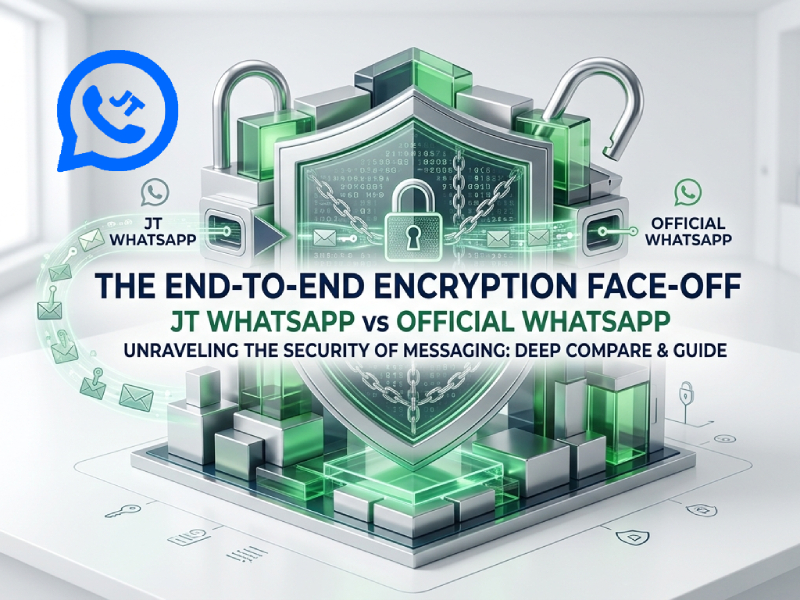
Understanding End-to-End Encryption
End-to-end encryption (E2EE) is a technology designed to secure the transmission of messages between users. It ensures that only the sender and the intended recipient can view the conversation content.
When a user sends a message, the message is converted into encrypted data before leaving the device. This encrypted information is transmitted over the internet and message servers in a form that is difficult for others to understand. Once the message reaches the recipient, it will be decrypted and displayed normally in the chat window.
A simple way to understand end-to-end encryption is to imagine putting a letter in a locked box. Only the person with the correct key can open the box and read the letters. Even if the box passes through multiple locations during transmission, the contents of the message will remain protected until it reaches the intended recipient.
Modern messaging platforms use end-to-end encryption to secure various types of communication, including:
- Text messages
- Voice messages
- Photos and videos
- Documents and files
- Voice calls
- Video calls
- Group conversations
With the continuous development of online communication, end-to-end encryption has become a standard feature in many popular instant messaging applications. It helps users have more peace of mind to conduct personal conversations, work discussions, and share multimedia content across different devices and networks.
How the Official WhatsApp Uses End-to-End Encryption
The official WhatsApp uses end-to-end encryption to protect conversations between users. This technology ensures that messages are secure from the sender’s device to the recipient. During transmission, the message remains encrypted, meaning that no one outside the conversation can view its contents.
WhatsApp has fully implemented end-to-end encryption across its platform, providing consistent protection for different types of communication. The encryption system runs automatically and requires no special settings from the user. After a chat is created, the protection feature will be automatically enabled in the background without affecting the user experience.
This encryption covers a wide range of communication features, including:
- Text messages
- Voice messages
- Photos
- Videos
- Documents
- Voice calls
- Video calls
- Group conversations
- Shared locations
When a user sends a message, a unique encryption process converts its content into unreadable data before the message leaves the device. Only the receiving device possesses the key required to decode and display the original message. Even if the data passes through a server during transmission, the message content is protected throughout the entire transmission process.
In group chats, the encryption process works in a similar way. The message is encrypted before being sent, and only group members can decrypt it. This allows participants to communicate while maintaining the same level of message security as in one-on-one conversations.
Because the encryption system operates automatically, most users hardly notice its presence in daily use. Messages are sent and received instantly, while the underlying security processes run continuously in the background. This combination of robust protection and ease of use has become one of the key features that distinguishes WhatsApp from many traditional instant messaging platforms.
How JT WhatsApp Handles Message Encryption
JT WhatsApp is based on the same messaging platform as WhatsApp, so many of its communication features work in a way that users are familiar with. When users send text messages, photos, videos, voice messages, or documents via JT WhatsApp, the data is transmitted through the WhatsApp messaging network, providing a conversational experience similar to the official app.
From the user’s perspective, the encryption process is almost transparent. The message is prepared on the sender’s device, transmitted through the messaging infrastructure, and then displayed on the receiver’s device without any additional processing. Most users will only notice that the chat function works normally and communication remains fast and reliable.
JT WhatsApp also supports many of the everyday messaging features found in the official app, including individual chats, group conversations, media sharing, voice messages, and status interactions. With the release of the JT WhatsApp New Version 2026, users can continue enjoying a familiar communication experience while accessing additional customization options. Because it operates within the broader WhatsApp ecosystem, users can stay connected with friends and family who use the standard version of WhatsApp without changing how they send or receive messages.
For most people, the difference lies not in how messages are exchanged, but in the appearance and operation of the application. Sending text messages, sharing vacation photos, forwarding files, or participating in group discussions is very similar to the experience offered by the official WhatsApp app, so many users can switch between the two with just a few tweaks.
Encryption Process Comparison
The following table highlights the major similarities and differences between JT WhatsApp and the official WhatsApp application.
| Feature | Official WhatsApp | JT WhatsApp |
| End-to-end encrypted chats | Yes | Uses the same messaging framework |
| Text message encryption | Yes | Similar messaging transmission process |
| Voice message encryption | Yes | Supported through the same network structure |
| Media file encryption | Yes | Functions similarly during message delivery |
| Group chat encryption | Yes | Available through WhatsApp servers |
| Voice calls | Supported | Supported depending on the version |
| Video calls | Supported | Supported depending on the version |
| Security code display | Available | Usually available |
| Chat transmission method | Official WhatsApp infrastructure | WhatsApp-based infrastructure |
| User customization options | Limited | Extensive |
Does Encryption Affect Daily Usage?
For most users, end-to-end encryption runs entirely in the background and does not change how they use applications. With features such as JT WhatsApp Anti-Ban, users can continue enjoying a stable messaging experience while messages are automatically encrypted when sent and automatically decrypted when received, ensuring smooth, secure, and uninterrupted communication.
In daily communication, users can send text messages, voice messages, pictures, videos, documents, and other files as usual. The encryption process takes only a few seconds and is usually transparent to both the sender and the receiver.
Many people believe that encryption may slow down message delivery, but modern devices and messaging protocols are well-designed to handle encryption efficiently. Therefore, users will hardly notice any difference in message delivery speed in everyday conversations.
Encryption is also applicable to various types of communication. Whether it’s a one-on-one chat, participating in a group discussion, making a voice call, or initiating a video call, the protection mechanism remains active throughout the entire communication process.
For businesses, students, travelers, and ordinary users, the overall experience remains simple and convenient. The methods for sending and receiving messages are the same as before, while encryption silently protects communication security in the background. The combination of convenience and privacy is one of the reasons why encrypted messaging has become a standard feature in modern communication applications.
Which App Provides More Features?
If the comparison is limited strictly to messaging functionality, both apps allow users to:
- Send messages
- Share media
- Create groups
- Make calls
- Exchange files
However, JT WhatsApp offers a wider range of customization tools.
Users who enjoy changing themes, modifying layouts, and adjusting privacy settings will typically appreciate the extra flexibility offered by JT WhatsApp.
Meanwhile, users who prefer a simple and clear interface may choose the official application.
Final Thoughts
End-to-end encryption remains a core component of modern instant messaging. JT WhatsApp and the official WhatsApp app both run within the same instant messaging ecosystem, enabling users to communicate via encrypted channels in their everyday conversations. The JT WhatsApp encryption feature follows the same fundamental communication framework, helping ensure that messages are protected during transmission while maintaining compatibility with users on the official platform.
The biggest difference between the two usually lies in the customization settings, interface controls, and additional user options, rather than the basic messaging flow itself.
For users who value personalization, JT WhatsApp offers richer visual and functional settings. For users who prefer a simpler experience, the official WhatsApp offers a familiar interface and the same core instant messaging features.
Understanding the communication methods of these two apps helps users make informed choices based on their preferences for functionality, appearance, and communication experience.